By the RAAD team
A thermometer is not a cold chain temperature record
Listen to this article
A trailer thermometer reports the air, not the product. A cold chain temperature record that holds up months later shows the product's own temperature, its location and how long any exposure lasted. A box thermograph can read a comfortable 4 C for the whole trip while produce at the centre of the pallet stays several degrees warmer, spending the shelf life you promised the buyer.
What a defensible cold chain record must contain
Any temperature log that has to support a shelf-life claim or a payment dispute needs four properties. Treat them as the minimum checklist whether you are evaluating a carrier, a supplier or your own operation.
| Property | Why it matters |
|---|---|
| Pulp and supply-air readings | The gap between product temperature and air temperature is the early warning that the load is at risk even when the box reads cold. |
| Rate of change | A threshold crossing only records an excursion after it starts. The slope reveals a fast rise from an open door, a defrost cycle or a pallet blocking airflow. |
| Buffered readings | When connectivity drops, a device that stores readings locally and forwards them after reconnection keeps the record continuous. |
| Auditable export | Route, time out of range and mean kinetic temperature (MKT) in a format a buyer or an authority can read. |
| MKT is a single calculated temperature that weights each reading by how much heat-driven quality loss it caused, so short warm spells count against the record more than long cool stretches do. |
Why air temperature and pulp temperature drift apart
Three physical facts shape every reliable temperature record, and an air-only thermograph captures none of them fully.
The trailer holds what it is given
A refrigerated unit maintains the temperature the produce enters with; it does not remove field heat from warm fruit. For delicate produce such as berries, standard post-harvest practice is forced-air cooling down to around 0 C as quickly as possible after harvest, before loading. Skip precooling and the load spends the trip fighting itself.
Pulp runs behind the air
The return or supply-air sensor can read 4 C while the centre of the pallet, the pulp temperature, runs several degrees warmer. An air reading can therefore support sign-off while the warmer pulp keeps consuming shelf life.
Exposure is cumulative
Under the Q10 rule of produce physiology, respiration in fresh produce roughly doubles or triples for every 10 C rise. A couple of hours at the wrong temperature adds to cumulative respiration and shortens remaining shelf life, and that loss remains even after the load is cooled back down. It can explain otherwise mysterious rejections.
A 7-point check for your next shipment
Run through this list before the next load leaves the yard.
- Precool first. Force-air cool delicate produce to its target pulp temperature as quickly as possible after harvest, before loading.
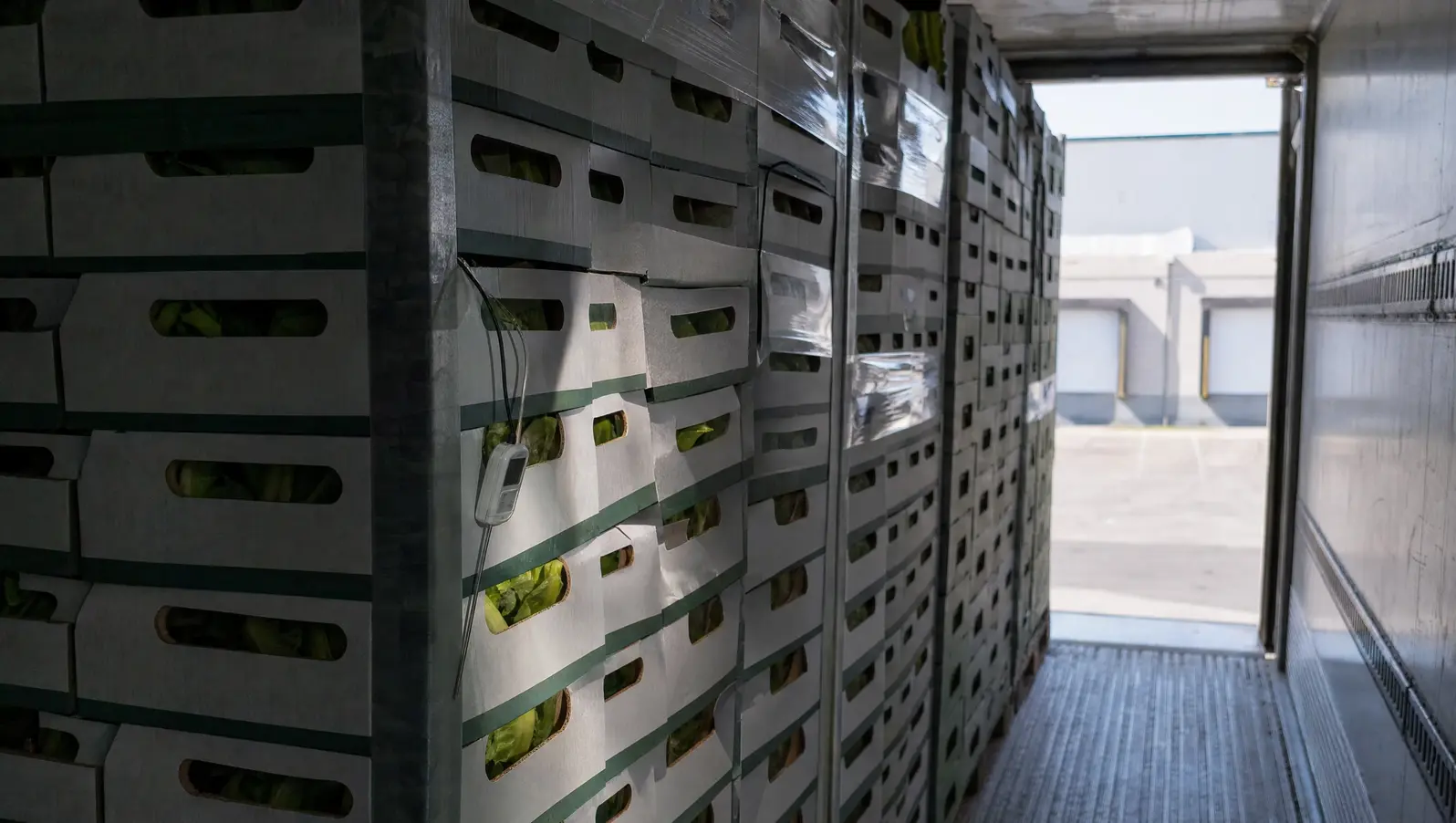
- Measure pulp and air. Place at least one sensor at the centre of the pallet and compare it against supply air.
- Verify before loading. Confirm the unit arrived cold and that logging was already capturing before the doors opened.
- Confirm buffering behaviour. Know which device stores readings during a connection loss and sends them afterwards, and test that it does.
- Set the range and the slope. Configure both a threshold alert and a rate-of-change condition so you learn about a door left open, not only a breach that has already happened.
- Agree the evidence format. Ask for exports that include route, time out of range and MKT, agreed with the buyer in advance.
- Set the retention period. Identify which rule governs this shipment, whether sanitary transport, traceability, a customer contract or a certification, and configure your archive to match it.
What the record can and cannot settle
A good temperature record shortens a dispute; it does not prevent one. When you can show pulp, air, recovered buffered readings and MKT alongside the route, the temperature portion of a buyer disagreement resolves much faster.
Be clear about the limits. Temperature evidence answers temperature-related questions such as shelf life and payment deductions tied to heat exposure. It does not cover rejections with other causes, such as pesticide residues, which are documented separately. In the United States, the sanitary transport rules require shippers of temperature-controlled food to hold written temperature-control procedures and to verify precooling before loading, and carriers must demonstrate maintained conditions on request. Other jurisdictions have their own written-procedure requirements, so record whichever rule applies to your lane.
Where RAAD fits the picture
The four properties above are vendor-neutral. What a fleet operator gains from RAAD is the surrounding context that turns a temperature log into evidence: trip and stop history with location and timing from Track, temperature, humidity and door state at fixed sites such as cold rooms and dispatch bays from Sense, and alert triage in AI Insights, so a genuine excursion reaches a person with a reason attached instead of every threshold ping competing for attention. The Documents module keeps expiry and inspection reminders current, which is where written procedures and retention commitments live. RAAD captures and presents the record; whether that record satisfies a given rule is a determination you and your buyer make together.
Common questions
Is a reefer's own temperature display enough as evidence?
It shows supply air at one point, not what the product experienced. Without pulp readings, rate-of-change history and a continuous record, a display cannot support you when a buyer questions a load months later.
What is mean kinetic temperature and why do buyers ask for it?
MKT summarises the whole journey into one weighted temperature. It gives more weight to warm periods because that is where quality is actually lost. Two loads with the same average temperature can have very different MKT values, and the higher MKT load has less shelf life left.
How long should I keep the record?
Long enough to cover the longest retention rule that applies to the shipment, whether that is a sanitary-transport requirement, a traceability rule, a customer contract or a certification scheme. Write that period into your procedure and configure the archive against it.
Your next step
Apply the 7-point check to your next shipment. If your record already has the four properties, keep the process. If it lacks any of them, you now know exactly what to ask for, and what to put right before the load, not after the invoice is discounted.
One platform for every connected asset
Tracking, power, cameras, metering and compliance in one console — resold under your own brand and billed by you.
Explore the RAAD platform