By the RAAD team
Pulp temperature checks before a reefer load departs
Listen to this article
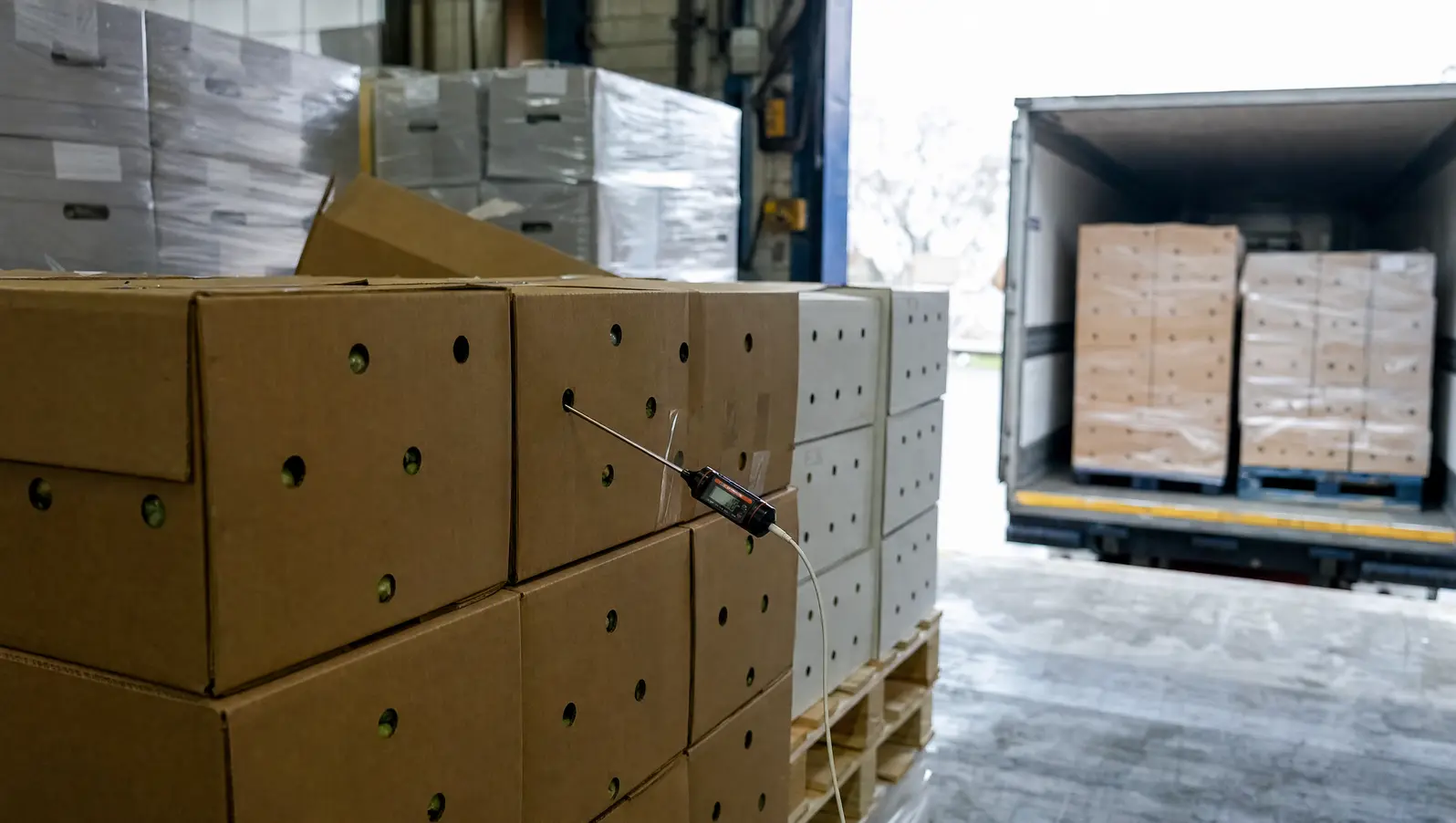
A refrigerated trailer can hold a load at temperature, but it cannot prove the load started cold. The proof is a pulp temperature reading: a probe pushed into the product at the core of a pallet. No refrigerated load should leave the dock without one.
Why the display is not enough
A transport refrigeration unit is built to maintain a pre-cooled load against the heat entering through the walls, not to pull field heat out of warm product. Its supply-air sensor reads the air coming off the coil, and that air reaches the target within minutes of start-up. The product cools far more slowly, and unevenly, from the outside of the pallet inward. So a display can show a clean setpoint, the target temperature the unit is set to hold, while the core of the load sits several degrees above it.
Fresh produce keeps living after harvest. It respires, burning stored sugars and giving off heat, and the pace of that work climbs steeply with temperature. A long-standing rule of thumb in postharvest handling holds that deterioration roughly doubles for every 10 degrees C rise. The figure is a guide that no single lot will follow exactly, but it explains why a few warm hours at the dock cost more than the same hours spent rolling.
This is why pre-cooling exists: it removes field heat from the product before loading, by forced-air cooling, by hydro-cooling, or by time in a cold room. Once the doors close, the unit maintains the condition it receives. Load the trailer with a warm core and the air may hold setpoint for the whole journey while the product never reaches its carrying temperature, the band the commodity must stay inside from departure to arrival.
The two readings answer different questions, and a release decision needs both:
| Reading | What it measures | How it moves | What it proves |
|---|---|---|---|
| Supply air | Air coming off the unit's coil | Quickly, within minutes of start-up | The unit is working and holding its setpoint |
| Probe at the pallet core | The product itself | Slowly and unevenly, from the outside of the pallet in | The load has actually reached its carrying temperature |
Pulp temperature and the pre-cool gate
The pre-cool gate turns load-out, the staging and loading of the trailer, into a formal checkpoint. The trailer is released only when four conditions are confirmed, and just one of them shows on the unit's display.
Picture the card clipped to the dock rail. The unit is holding, the load plan is cleared, the recorder is armed, and the line for the product reading is blank. That blank line is the whole case for the gate. Release a load on three checks and a good display, and it leaves the dock with its starting condition unverified.
- The unit is at setpoint and holding. A brief touch of the target is not stability. Decide how long the reading must hold before release and write the rule on the card, so every shift applies the same one.
- The product is inside its corridor. Probe the core of the pallet and compare the reading against the commodity's target. This is the line the display cannot supply.
- The load plan preserves airflow. Conditioned air has to travel through the stow and back. A blocked return path or an overloaded nose turns a working unit into a warm pocket.
- The record is running before departure. Produce-trade best practice is to write the probe reading at loading, plus the locations and serial numbers of the temperature recorders on the load, on the bill of lading before the doors close.
The fourth line is what carries dock evidence into any later argument. Release a load with the product line blank and you have sent it on the strength of the box rather than the cargo.
The record that answers a claim
When a receiver opens a good-delivery claim, the destination inspection captures one snapshot at the end of the trip. The starting condition has to be proved by records.
Receivers raise problems quickly, and the formal inspection that follows is a single reading at arrival. It cannot show where in the journey the temperature left the corridor, or whether the product was ever inside it. A continuous story from loading to arrival answers the three questions a temperature dispute turns on: was the product inside the corridor when the doors closed, did it stay there, and if it strayed, when.
A probe reading taken at loading anchors the first of those questions. A supply-air trace alone leaves the starting condition open, and that gap is exactly where a claim grows.
Temperature is rarely the whole of a dispute. The contract, condition defects at arrival, the loading pattern and the unit's own data all carry weight. Separately, most modern food-safety regimes expect records that identify the food and trace it one step back and one step forward. One habit covers both: create the evidence when the event happens, before anyone knows whether a claim is coming.
A self-audit for the next load-out
Five questions on the dock will show whether the gate is a discipline or a ritual.
- Where in the pallet is the probe placed, and where is each reading recorded?
- How long must the unit hold setpoint before release, and is that rule written down?
- Who checks the load plan and confirms the supply and return airflow paths?
- When does the temperature record start, and which probe reading anchors it?
- If a receiver opened a claim tomorrow, could you produce the full series from load-out within minutes?
A soft answer to any of these marks a condition to correct before the next doors close.
Where RAAD fits at the dock
Any operation can run this gate with a card and a probe. RAAD carries the sensing, alerting and paperwork that keep it honest.
RAAD's Sense module watches temperature, humidity and door state at fixed sites such as cold rooms and loading docks, so the environment the pallets wait in is monitored continuously rather than sampled once at start-up. Door state matters here as much as temperature: a cold room propped open during loading quietly undoes an hour of pre-cooling.
A geofence around the dock in Track anchors the timeline, and rules can watch those readings through the whole load-out. AI Insights reads every alert, holds back what does not need a person, and brings the rest with a reason and a proposed fix. Nothing touches a vehicle until someone approves it. Scheduled reports then pull the series together when a claim lands, instead of someone assembling it by hand afterwards.
The paperwork lives in RAAD too: the trailer in Assets, its load-out card and recorder serial numbers in Documents, with document expiry and inspection reminders that keep the checks from silently lapsing. The probe reading itself stays a physical act on the dock, and airflow stays a physical inspection of the stow. RAAD makes sure those readings are taken, kept and easy to find. It does not certify food-safety, contractual or good-delivery compliance.
Common questions
Where should the probe go?
Into the core of the pallet, where cooling is slowest, and on more than one pallet in the load. Pallets loaded last or nearest the dock door are worth including. Write every reading down with the place it came from.
How long must the unit hold setpoint before release?
Long enough that the reading is steady rather than a brief touch of the target. The exact period is your operation's rule to set. The point of the gate is that the rule is written down and identical for every shift.
Is a supply-air trace enough in a dispute?
It proves the unit worked. It does not prove the condition the product started in. Pair it with a probe reading at loading and a continuous series to arrival, and the temperature part of the story is complete.
Hold the next load at the gate until the product line on the card is signed. The display tells you the box is cold. Only the probe tells you the cargo is.
One platform for every connected asset
Tracking, power, cameras, metering and compliance in one console — resold under your own brand and billed by you.
Explore the RAAD platform