By the RAAD team
The Freeze Risk Most Cold Chain Monitoring Misses
Listen to this article
Most cold chain monitoring is built to catch heat. A freeze-sensitive product can be ruined by dropping below its lower limit while the refrigerator's own log still reads normal. Closing that gap takes three controls: a lower-bound rule, a probe placed with the product, and a warning when readings fall fast toward the floor.
Why cold chain freeze risk gets missed
Monitoring effort piles up on the ceiling of a product's temperature range. The floor goes unwatched. Every temperature-sensitive drug or vaccine travels inside a validated corridor, the tested temperature range it is approved for, and that corridor has two edges. Field reviews of vaccine distribution have repeatedly found freeze exposure in a large share of refrigerators and shipments, usually because equipment configured to protect against heat overshoots at the bottom of the range.
The blind spot persists because freeze damage is often invisible. Adsorbed vaccines, whose antigen is bound to an adjuvant, can lose potency when frozen and show no outward sign, and the shake test used in immunization programmes can only confirm the damage once freezing is already suspected. Without monitoring that watches the cold side specifically, the first signal is a failed potency check arriving days or weeks after the exposure. By then the team is investigating a loss rather than preventing one.
Three controls that set a freezing floor
A heat-only rule cannot see the bottom of the range. Three additions can, and together they form a freezing floor: a lower bound the operation can enforce, plus a continuous record the quality team can investigate.
A lower-threshold rule
This rule fires when a reading crosses the product's configured lower limit, or the freezing point where that is the boundary, exactly as an upper-threshold rule fires on heat. It is also the control most often left out. Monitoring setups tend to be configured ceiling-first and then never revisited.
A probe placed with the product
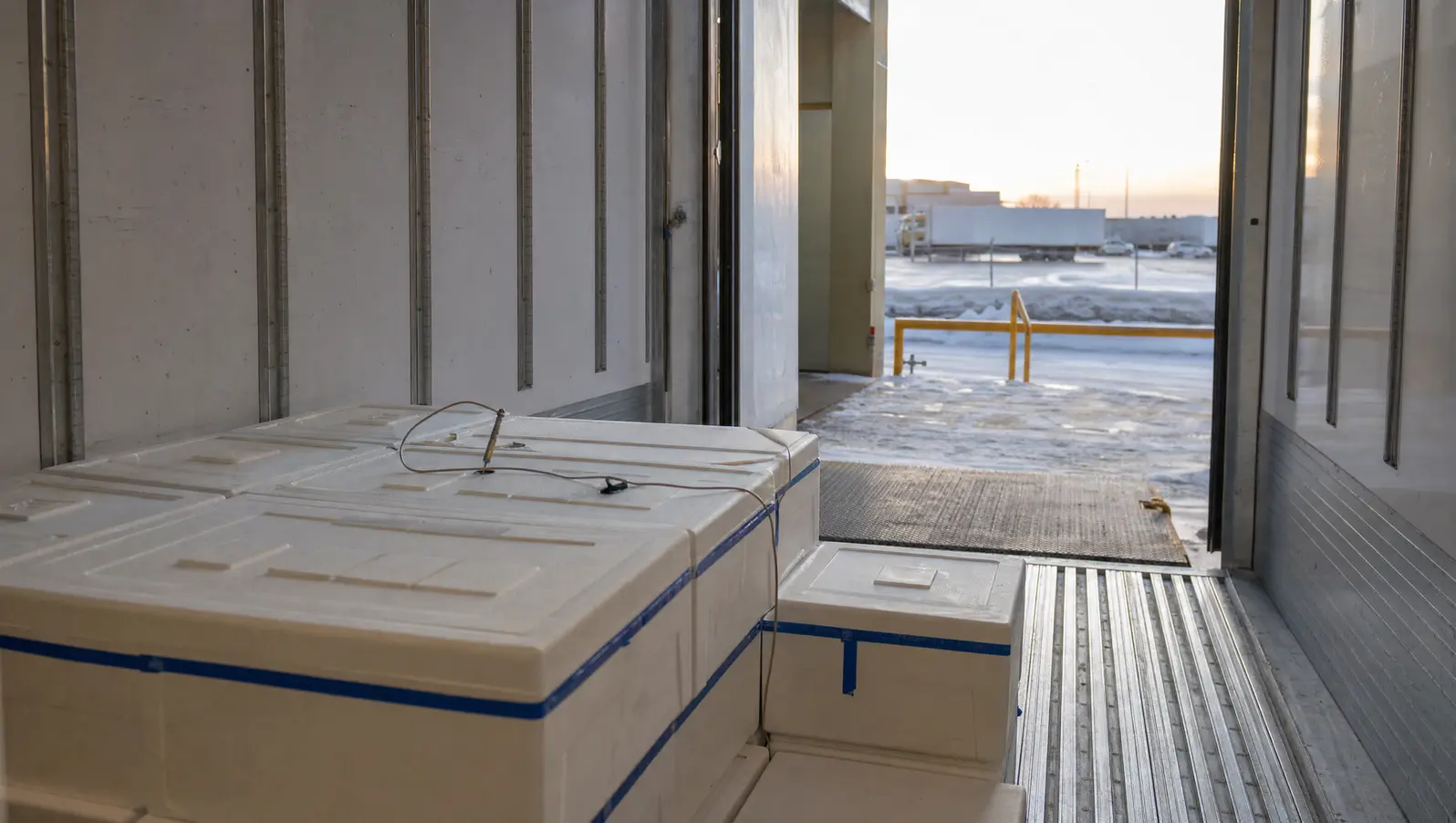
A fridge or a refrigerated container reports its own air, and that is rarely where the product sits. Vials against a cold wall, the evaporator or an ice pack can freeze while the unit's average reading looks fine, so at least one probe belongs inside the load: a carton, a tray, a vial rack. Public-health storage guidance names door shelves and crisper drawers as the classic fluctuating spots in a pharmacy fridge, and the same logic scales to a cold room or a distribution freezer. The reading at the product is the one that matters.
A rate-of-change watch ahead of the limit
Rate-of-change is how fast a reading is moving, not where it sits, and watching it gives the earliest warning of the three. A reading falling fast toward the configured lower limit is the condition for prompt investigation, raised before the limit is crossed rather than after. A fast fall can point to abnormal cooling, a door left open on a cold night, or a cold pocket forming around part of the load. The trend flags the situation for a person. Determining the cause and the outcome remains the operator's investigation.
Set side by side, ceiling-only monitoring and a monitored floor differ on almost everything a quality review asks about.
| Attribute | Heat-only monitoring | Monitoring with a freezing floor |
|---|---|---|
| What fires an alert | The upper limit crossed | Upper and lower limits crossed, plus a fast fall toward the floor |
| First signal of a freeze | A failed potency check or a shake test, days or weeks later | A rule or a rate-of-change warning while the product can still be moved |
| Evidence captured | Time above the ceiling | Time out of range on both sides, on one continuous record |
| Typical response | Investigate a loss | Prevent an excursion |
The record a quality team can actually use
An excursion is only as defensible as the record behind it. That record starts with time-out-of-range: how long, and by how much, the product sat outside its validated corridor on each side.
Where the product and the quality procedure allow it, that record is often paired with mean kinetic temperature, or MKT, a single calculated temperature that simulates the cumulative stress of varying storage temperatures through a weighted formula, not a simple average. MKT is a standard metric for storage records and is sometimes accepted for transit excursions, but it does not replace evaluating a specific excursion.
Regulators make the stakes explicit. In Canada, GMP guidance requires storage refrigerators and freezers to carry continuous-monitoring sensors placed where temperature is most likely to deviate, holds distributors and wholesalers to the same GMP framework as manufacturers, and allows an excursion to be accepted only with documented scientific justification. The same guidance warns that MKT may not be appropriate for refrigerated products or biologics. Whatever market you operate in, the point holds: a daily minimum and maximum cannot support the same investigation and disposition work as a continuous series.
How the three controls run in RAAD
The controls work with any sensor brand that is calibrated and placed correctly. RAAD connects to the hardware you already run without replacing it.
For fixed sites such as cold rooms, pharmacy fridges and cold storage, the Sense module reports temperature, humidity and door state continuously. You can run a lower-bound rule beside the upper-bound one, pointed at the probe in the load instead of the unit's own air sensor. Because every reading sits on one timeline, a fall toward the lower limit shows up as a trend before it becomes an excursion, and scheduled reports can carry the temperature record to the quality team on the cadence it chooses.
When an alert fires, AI Insights reads it, holds back what does not need a person, and brings the rest with a reason and a proposed fix. That way a fall toward the floor in the middle of the night reaches someone with the evidence attached instead of disappearing into alert noise. RAAD does not certify GMP compliance. Your quality system decides whether the captured record satisfies the obligations in your market. RAAD's job is to make sure the data your quality team needs was actually captured, floor included, on the same account that already holds your vehicles, locks, cameras and paperwork.
A five-point self-audit
Run these checks while you still have the monitoring configuration in front of you, and give every uncertain answer an owner and a test date.
- Does your monitoring have a floor alert as well as a ceiling? Would a reading of 0.5 C fire anything at all?
- Is at least one probe in the product, such as a carton, tray or vial rack, or is every probe on the unit's own air sensor?
- Would a fast fall toward the configured lower limit be flagged before the limit is crossed, or only after?
- For actively temperature-controlled transport, could you produce mapping and monitoring evidence for the vehicle or container? For a qualified passive package, could you produce its documented, risk-based qualification?
- Is your exportable record time-out-of-range and, where applicable, MKT, or a daily average that can hide a brief but real excursion?
Common questions
Can a fridge log really look normal while the product freezes?
Yes. The unit's own sensor reports the air it measures, often close to a cabinet average. Product resting against a cold wall, the evaporator or an ice pack can sit well below that reading, so the log stays green while part of the load freezes. That is why at least one probe belongs in the load itself.
Is a lower-limit alert enough on its own?
It tells you the excursion happened, but only after the fact. A rate-of-change watch opens a window to act while the product can still be moved, and a product-level probe tells the rule what the load, not the air, is experiencing. The three controls earn their keep together.
Does MKT replace investigating a freeze event?
No. MKT is a weighted summary of cumulative thermal stress. It does not prove the product stayed safe, and Canadian GMP guidance warns it may not suit refrigerated products or biologics at all. A freeze excursion still has to be evaluated on its own time-out-of-range evidence before any product decision is made.
Start by checking whether your monitoring has a floor as well as a ceiling. Configure a lower-bound rule, put a probe with the product, and make sure a fast fall toward the lower limit reaches a named person. Then test each control against the product's validated range and document the result. A freezing floor only counts once someone has proof it holds.
One platform for every connected asset
Tracking, power, cameras, metering and compliance in one console — resold under your own brand and billed by you.
Explore the RAAD platform